


This week, I released the State of Digital Agencies 2025 and today, I want to talk about one of the key takeaways from this survey that managers should be aware of.
In summary, fewer and few agencies are based in the office full-time, whilst more and more are choosing a hybrid approach:

Whilst this almost certainly isn’t a surprise, I did find it a little surprising that for those agencies that are choosing the hybrid approach, their team members are choosing to spend more time in the office compared with a year go:
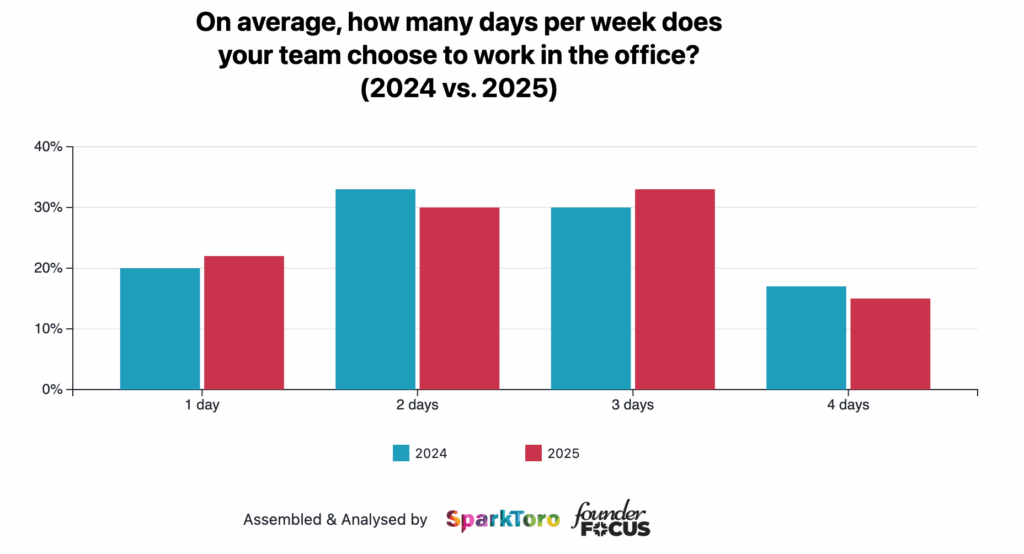
As you can see, the most popular answer in 2024 was 2 days a week spent in the office. Whilst in 2025, the most popular answer was 3 days.
We could infer a number of things from this data but my focus today is on what you should be doing as managers and leaders to get the most out of your teams. If they are indeed spending more time in the office, you need to ensure that your hybrid approach is sound and that the time they spend in the office is valuable.
Hybrid work should work well – but it often doesn’t
In theory, a hybrid working environment is the best of both worlds for staff:
- We can still spend time with colleagues, but are also able to spend more time with family and friends due to saving on commute times / spending lunchtime at home etc.
- Those of us who find the office distracting can get their head down at home and focus on deep work.
- Whilst those of us who find working at home distracting, can still spend time in the office to get deep work done.
For some teams, this balance works well but for others, it has proven to be challenging.
Years into the shift, most organisations are still wrestling with it – unclear expectations, inconsistent policies, a disconnect between office and home productivity, and teams who feel caught between two worlds.
This can prove hard for managers too who can’t necessarily control things like policies and the wider organisational culture.
Effective hybrid work is possible though – but only if we design it with intention rather than defaulting into it.
Used well, hybrid work increases productivity, improves retention, supports wellbeing, and strengthens culture.
Used badly, it creates confusion, disconnection, mistrust and uneven performance.
I can’t tell you exactly what to do. Because the goal isn’t to copy another company’s model – but to build one that works for your culture, your team dynamic, and your goals.
Let’s look at how you can actually do this.
What your team are actually struggling with
Most complaints about hybrid working aren’t really about location – they’re about clarity, fairness, and experience. If complaints are about location, they are usually about the value of working in the office vs. at home, or about having to spend time commuting into the office.
Common complaints include the following.
Unclear rules about when to be in the office
Teams hate vague guidance like “be in when it makes sense.” or “we’ll leave it up to you.”
Nobody knows what “makes sense” means.
Inequity between those in-office vs remote
Those physically present can appear more engaged or visible, creating advancement biases compared with those who aren’t as visible to their managers or colleagues.
Meetings that favour in-office voices
Remote team members can often feel like spectators rather than contributors. This is especially true when technology perhaps isn’t as good as it could be or even something as simple as home internet connections not being consistent.
Culture erosion
Hybrid working can weaken relationships if there are no intentional touchpoints holding people together. People simply aren’t as close as they would be as when they are consciously trying to build strong relationships with each other.
What employees want isn’t unreasonable – they want a model that feels fair, predictable, and supportive of good work.
Not just some of the time such as when they are at home or at home. They want it consistently.
What successful hybrid models get right
A strong hybrid working environment doesn’t happen accidentally. It’s not the same as the old style of in-office working where in most cases, it was your job to just not get it wrong.
Instead, you need to be very deliberate about four things.
1. Clear, explicit expectations
People know and understand the basics such as:
- What days are office days.
- What deliverables matter most.
- What behaviours are expected of them and colleagues.
- How success for them and their projects is measured.
Regardless of working location, they know the answers to these questions. No guessing, no whispered interpretations.
2. Office time has purpose, not presence
Coming into the office isn’t a box to tick, it’s time designed for activities better done in person such as:
- Collaboration.
- Deep discussion.
- Workshops.
- Mentoring.
- Relationship building.
If people commute only to sit on Zoom calls, they’ll resent the model. And honestly, who can blame them?
3. Remote time is protected and productive
Deep work happens best outside interruption-heavy environments. For some this is the office whilst for some, this is at home. But the truth is that for many, working remotely should enable deep work and focus.
Good hybrid systems treat remote time as high-focus work time – not “day off” or “taking it easy” time.
4. Psychological safety across both spaces
You need to ensure that there is no “in crowd” in the office.
You need to ensure that there are no “forgotten” remote workers.
Everyone has equal access, equal voice, equal progression from you as a manager.
In other words, successful hybrid models don’t prioritise location.
They prioritise quality of work and quality of human connection.
How hybrid workers can make the most of office days
Given that we know that teams are now spending more time in the office, we need to ensure that this time is well-spent.
The thing is, many hybrid challenges aren’t systemic – they’re tactical.
Your team will often go into the office without intention.
They turn up, open their laptop, and duplicate their remote environment in a building they just commuted an hour to reach.
To make office time valuable, employees should be encouraged to use it for things they can’t do remotely.
This can include practical behaviours that work best in the office, such as:
- Scheduling collaborative sessions rather than solo tasks to take advantage of being in the same location as colleagues.
- Using face-to-face time for quick decisions that get stuck on Slack.
- Pair people with new or junior teammates for in-person development that is harder to do remotely.
- Build relationships deliberately, not passively.
Office days should accelerate progress, not replicate remote work.
You can finish tasks anywhere. But you build trust, alignment and momentum much faster in person – if that time is used intentionally.
What managers need to do differently in hybrid environments
Hybrid leadership isn’t traditional leadership with a webcam added.
It requires new habits – especially around communication, planning, and presence.
Here’s what strong hybrid leaders do consistently:
They communicate more, not less
Silence creates anxiety, whilst clarity creates confidence and focus.
Hybrid teams need rhythm: updates, priorities, expectations – short, frequent, simple.
They design hybrid intentionally
They don’t leave it to chance and hope for the best. Instead, managers decide:
- What types of work suits working in the office and they communicate this to their team.
- What types of work suit remote working.
- What types of meetings are suited to office and remote time.
They create belonging in both spaces
Instead of belonging only being felt in person, effective managers ensure that their team has:
- Consistent recognition.
- Regular one-on-ones.
- Meeting structures that give remote voices equal airtime.
- Celebrations that everyone can access and feel part of.
They build trust through autonomy
If a hybrid working environment becomes surveillance, people disengage. They simply don’t feel trusted and start to question you as a leader.
If hybrid working becomes freedom without accountability, performance slips.
Leaders must balance trust + standards clearly. Demonstrating what high standards means and leading by example.
They pay attention to invisible workloads
Remote team members often overwork quietly.
Office-based members often carry emotional labour.
Hybrid leadership requires noticing how someone is feeling and working – then taking action to help if needed.
A framework for designing an effective hybrid work model
The one thing that you absolutely don’t need is a 50 page policy on hybrid working.
What you need instead is clarity on the following areas.
1. Purpose
Why does hybrid working exist in your business? Why did you choose it as your primary way of working?
Is it to do with cost? Talent flexibility? Collaboration improvement?
Teams engage more when they understand the why. This also helps communicate that hybrid working was a deliberate decision – not something that you just fell into.
2. Presence expectations
How do you expect your team to actually work?
How many days? Which days? Fully flexible or some structure?
Ambiguity is where frustration grows.
3. Work-Type Allocation
What types of work and communication belongs in the office vs remote?
For example, the office may be best suited for things like collaboration, planning, feedback, learning.
Whilst remote may be better for deep work, documentation, strategy creation.
4. Communication Protocols
How fast should people respond on platforms such as Slack, Teams or email?
Which channels for what? Should someone send an important message via Slack? Or should this be reserved for email or a phone call?
When is async preferred over meetings?
5. Evaluation + Iteration
Hybrid should evolve over time via quarterly reviews, employee input, small experiments to test improvement.
Hybrid working doesn’t have to be perfect – in-office working never was!
It just has to be intentional, transparent, and adaptable.
To wrap up, hybrid work isn’t going away and as we can see, more people are choosing to spend time in the office.
The real future of work isn’t remote or office-based – it’s designed, proactive and deliberate.
It is designed for clarity, connection, performance and the humans actually doing the work.
Hybrid won’t reward managers who hope it sorts itself out. It rewards those who deliberately shape it.